

The Brutalist
Updated: Feb 23, 2025
Antisemitism in Architecture, The Brutalist is a towering monument to the rage of the immigrant experience in America.
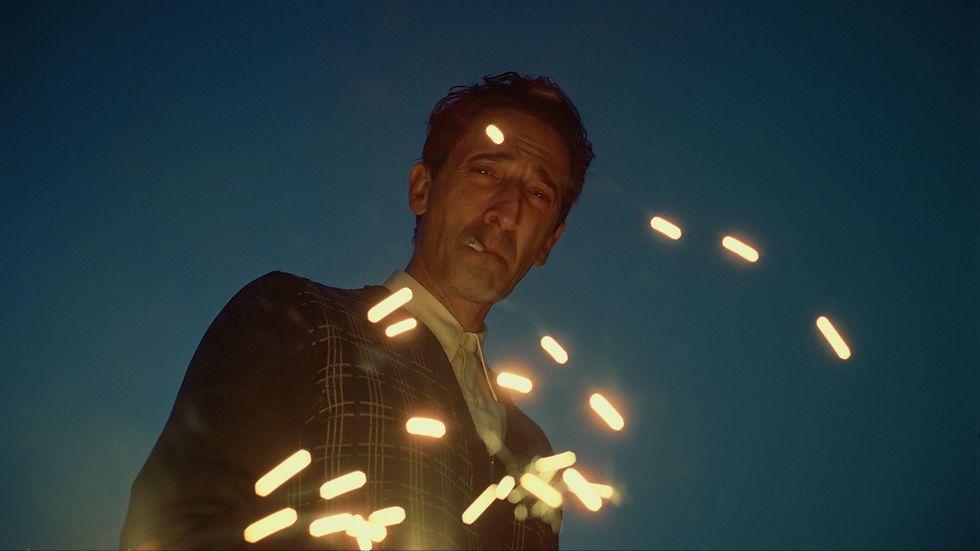
After escaping the Holocaust, Jewish Hungarian architect László Tóth (Adrien Brody) arrives in America, the land of opportunity and freedom, where he must work in his cousin’s furniture shop while he awaits the safe passage of his wife Erzsébet (Felicity Jones) and niece Zsófia (Raffey Cassidy). After building an irregularly shaped library for a wealthy client’s father who initially detests the design, László is forced into poverty, until his furious customer businessman: Harrison Lee Van Buren (Guy Pearce) tracks down László to commission him for a large-scale project that will be the edifice of a lifetime.
Adrien Brody in a career best performance, delivers an internal agony yearning to be expressed in his craft which ultimately becomes a tower of Babylon for the rich and powerful of Philadelphia. László is like the Man Who Fell To Earth, a mysterious foreigner with intelligent and ethereal talent who is gradually seduced and abused by the spoils of America: parties, music, sex, and prominently, opioids. László’s addictions become a way to heal his trauma, which is only escalated by the demanding work of building a multi-purpose centre with the overbearing pressure and egotism of Harrison. Brody escapes the smug Wes Anderson bravado for a sincerely powerful personal performance wrestling art against ego, survival against accomplishment, love against lust, respect against abuse. His face is one of the most expressively controlled in cinema, László’s personal scars are very close to his chest, but his fragility is all surfaced, Brody has an extraordinary way of crying which becomes almost like watching the gradual bloom of a flower.
Like the rest of the film's classical and rich aesthetic, Guy Pearce comes fresh straight from a 1940s America, reminding me personally of the ruthless charm of a Fred McMurray character. Harrison Lee Van Buren represents a conversative aristocratic community who upon discovering László’s talent give him much praise, but their attention towards him is nothing more than for their own amusement. “They don’t want us here!”, László exclaims to his wife, as years of institutional detesting against their foreign Jewish identity are unmasked while living in Harrison’s estate. Harrison and László’s business partnership becomes as toxic as Eli Sunday and Daniel Plainview’s in There Will Be Blood (2007).
Felicity Jones who is not a key character till the second half of the film, comes in with a nuanced but physically and psychologically alarming performance that comes to realise how the pursuit of the American dream has consumed her husband, and his soul consuming project has becomes his muse. Jones is painfully wounded but strong hearted in her struggle to maintain a life and marriage with László, while she is gracefully tended to by the silent Zsófia. If there is one thing that director: Brady Corbet has an inclination for, it is Raffey Cassidy’s face. The rest of cast includes Joe Alwyn, Stacy Martin, Isaach de Bankolé and Alessandro Nivola all deliver golden performances and feel as a piece with the rest of the picture.
Corbet's third directorial feature is a masterful epic of historical trauma come to life in structure. Corbet's passion project is impossibly grand and beautiful, it’s an ambitious undertaking to create three-and half-hour epic with a 15minute intermission on 70mm VistaVision, but he more than earns a place among the great directors with this entry. Corbet’s effort to erect a classic prestige picture follows a legacy in line with Coppola, Leone, and Scorsese, though today the Brutalist would probably be closer to the craftsmanship of Paul Thomas Anderson, another champion of celluloid spectacle. Corbet continues to cement a unique perspective on how the past trauma create the leaders and artists of today, Childhood of a Leader (2015) explored the political upbringings of a fascist dictator, Vox Lux (2018) dissected the pop culture effect of massacres and self-destruction, now with the Brutalist an intense examination of the significance of immigrant labour in the infrastructure of modern America. The speculation that this feat of a production was made for less than £10 million is nothing more than miraculous.
Not only does the film harken back to its post war period, but it feels like a treasure discovered in a vault left from the time gone past, as the production design is extensively tactile and real, even if minimalist on occasion. The magic trick is how the create the immersive illusion of László’s paradoxical construction which has a shadowy and extra-terrestrial presence like the monolith from 2001. While Lol Crawley’s crisp and magical cinematography is encompassing and intimate in handheld movement that is frequently eye-opening to the first-person encounters of László . But one of the defining elements of the Brutalist’s grandeur comes from Daniel Blumberg’s momentous score. Charging the prologue with an extravagant overture of mechanical clanking mixed with triumphant brass, Blumberg’s score also moves to softer piano and chaotic jazz. It is a symphony of extraordinary sound and power, quite unlike anything in living memory.
Corbet’s ten-year gamble to create such a picture is almost as daring and maddening as the central character’s own creation, and it is truly magisterial exhibit of historical and personal pain cemented in stone. How on earth did the kid who played Alan Tracey from the Thunderbirds movie do that?
A must see in Cinemas on the 24th of January.
“The day for building your walls will come, the day for extending your boundaries”- Micah 7:11
“to them I will give within my temple and its walls a memorial and a name better than sons and daughters; I will give them an everlasting name that will endure forever.”- Isaiah 56:5


Comments